<?xml version="1.0" encoding="utf-8"?><feed xmlns="http://www.w3.org/2005/Atom" ><generator uri="https://jekyllrb.com/" version="4.4.1">Jekyll</generator><link href="https://prosoche.co/feed.xml" rel="self" type="application/atom+xml" /><link href="https://prosoche.co/" rel="alternate" type="text/html" /><updated>2026-09-23T06:35:31+01:00</updated><id>https://prosoche.co/feed.xml</id><title type="html">ProSoCHE</title><subtitle>Small iOS and Mac tools for paying attention, grounded in Stoic and Buddhist practice, plus the notes of the person who builds and uses them.</subtitle><author><name>Bart Smaga</name></author><entry><title type="html">The Pause Is the Practice</title><link href="https://prosoche.co/2026/the-pause-is-the-practice/" rel="alternate" type="text/html" title="The Pause Is the Practice" /><published>2026-09-22T00:00:00+01:00</published><updated>2026-09-22T00:00:00+01:00</updated><id>https://prosoche.co/2026/the-pause-is-the-practice</id><content type="html" xml:base="https://prosoche.co/2026/the-pause-is-the-practice/"><![CDATA[<p class="shots"><img src="/assets/pp_pause_cover.webp" alt="Chart of my weight in 2026: a weekly average of 107.5 kg in early January, 98.2 kg by early September" /></p>

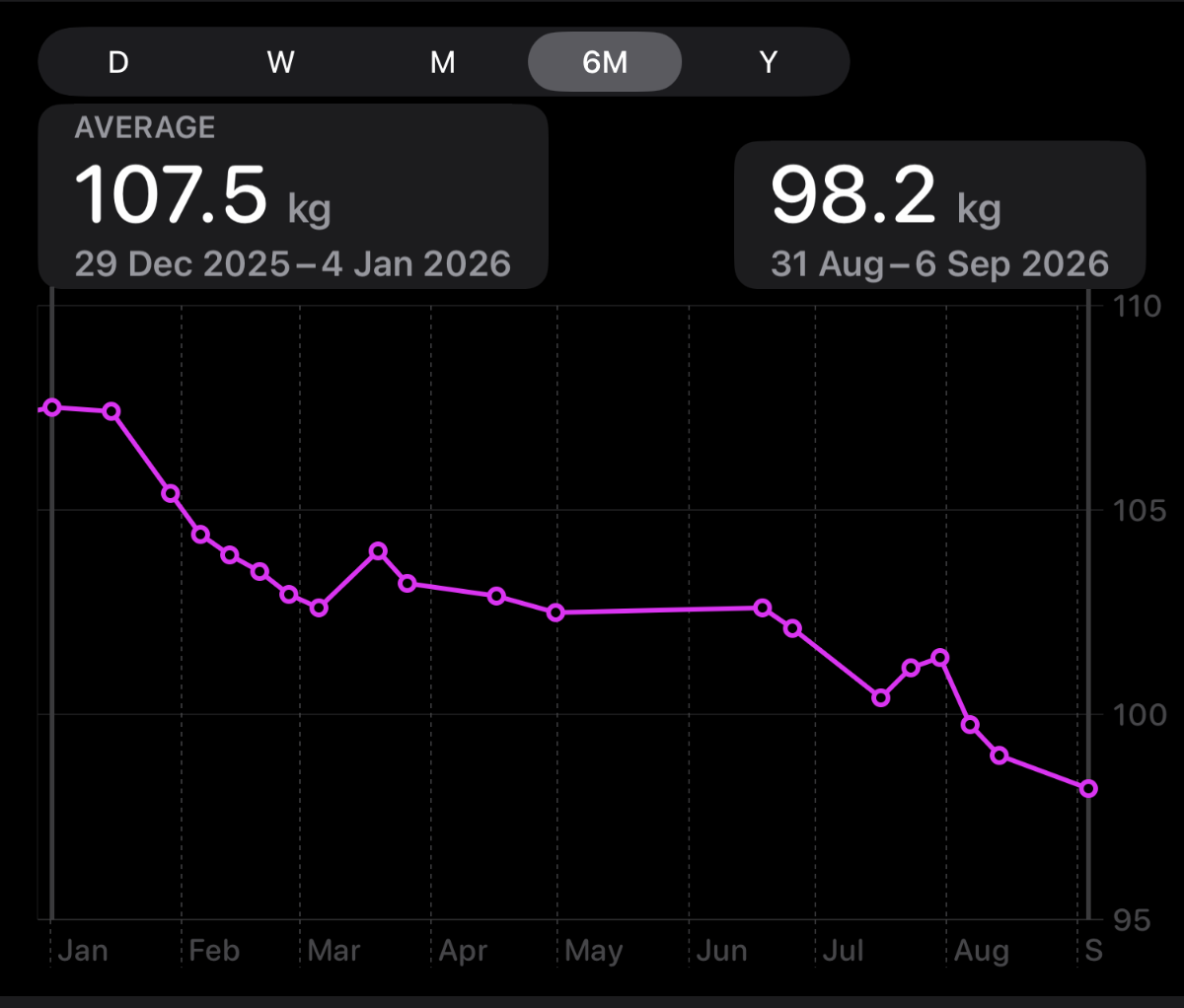
<p>The chart above is my story since the start of this year. Or, more precisely, the story of my weight. Ten years ago I was in a similar, if not worse, situation: I started from almost 120 kg and got down to 82, only to end up big again a few years later. This time the problem was different. I am ten years older, and what worked then (essentially punishing myself with diets and dozens of kilometres of running) no longer worked. I had been trying since 2024 without much to show for it, until at the end of 2025 I finally built something I called ProsoPlate. The idea was mindful eating: mainly paying attention to what I eat and how different foods leave me feeling. Something to help me change my relationship with food.</p>

<p>Since January I have released several versions of the app, looking for the setup that works best. Version 1.7, the one in the App Store now, is built around something I nearly broke along the way. Here is what happened. When I was simplifying <a href="/prosoplate/">ProsoPlate</a> for version 1.5, the pre-meal check-in looked like friction. Three questions before you are allowed to eat: how hungry are you, how strong is the pull, what are you feeling. Cut them, I thought, and logging a meal takes five seconds.</p>

<p>Then I understood that the point was never logging meals quickly, never just ticking them off. The checks are not data collection. They are the intervention. Everything else in the app is bookkeeping.</p>

<h2 id="the-loop-does-not-run-on-thinking">The loop does not run on thinking</h2>

<p>Eating that has nothing to do with hunger runs on a habit loop: trigger, behaviour, reward. The trigger might be stress, or boredom. The hand reaches for food, the discomfort eases, and the brain files the behaviour as worth repeating. Dr. Judson Brewer has spent his career on this loop, first with smoking, then with eating. His point is uncomfortable, but it landed with me: you cannot think your way out of the loop, because the loop does not run on thinking. It runs on feeling.</p>

<p>From the start I kept asking myself whether I could build an app that might break this loop, and if so, how. Let’s be honest: no app will do the work for us. We have to do it ourselves, or nothing changes. At most, an app can give us a framework, a scaffold that makes the work on ourselves a little easier.</p>

<p>And because the loop runs on feeling, the first thing we have to do, the very first, is slow down: a moment’s pause before eating. That moment is our chance to do something other than the usual, to choose a path that is even slightly different.</p>

<p>Observing your own feelings has a well-established place in Buddhist psychology. The practice has a name: <a href="/foundations/vedananupassana/">vedananupassana</a>, watching feeling-tone (pleasant, unpleasant or neutral) before it hardens into craving. In plain terms: two breaths between the urge and the first bite. I wrote about <a href="/2026/the-pull/">what the craving feels like when you watch it</a>, and about the brain imaging behind it.</p>

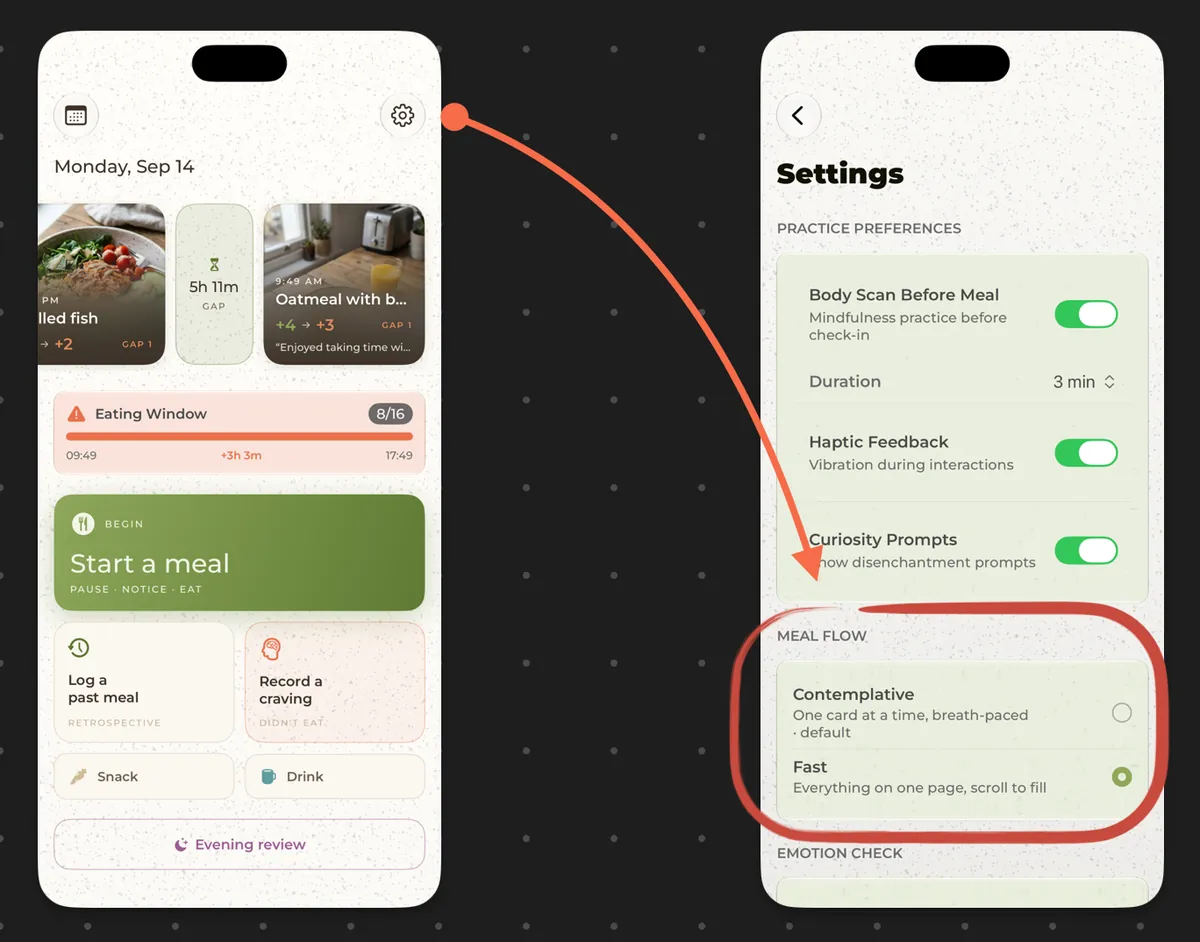
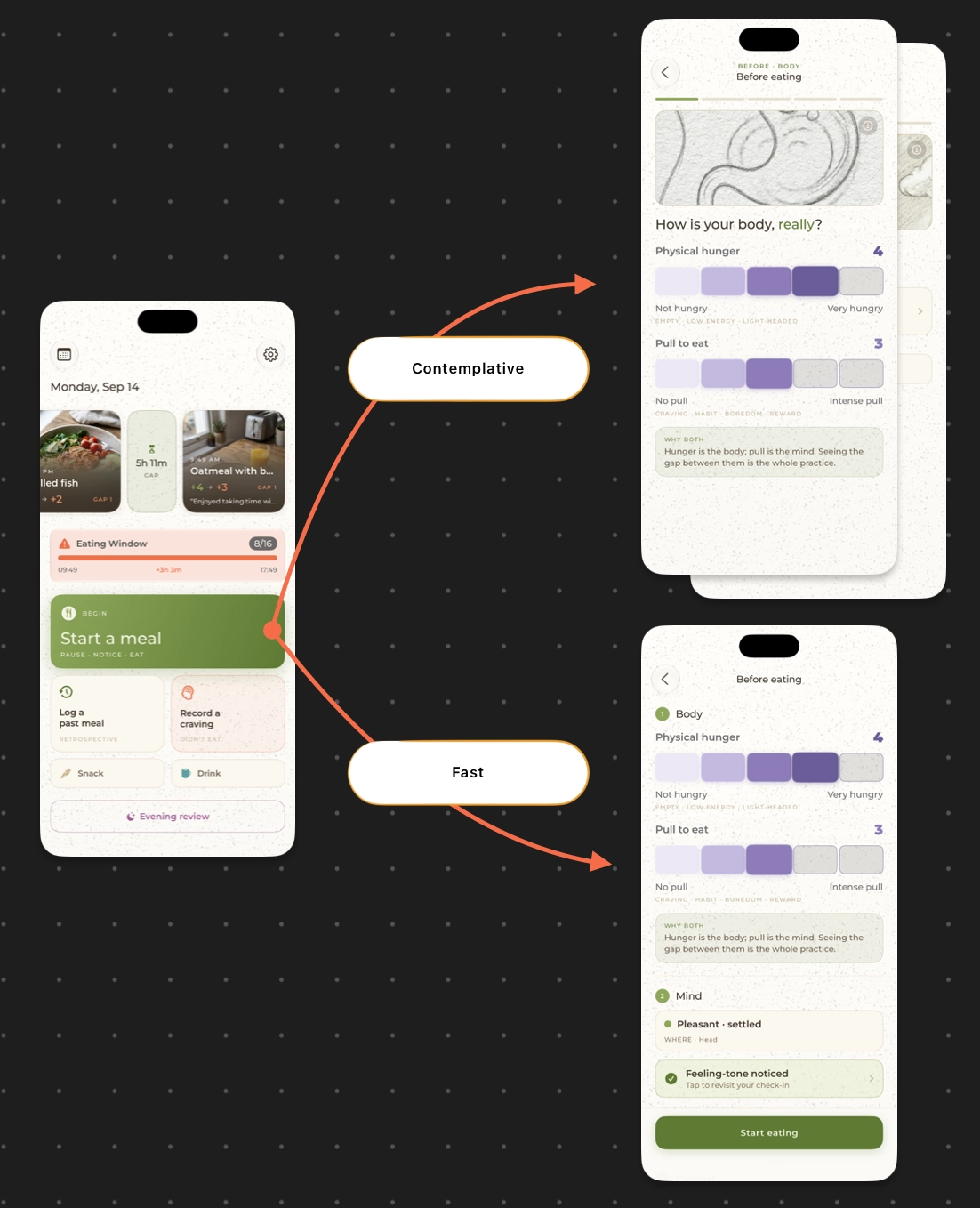
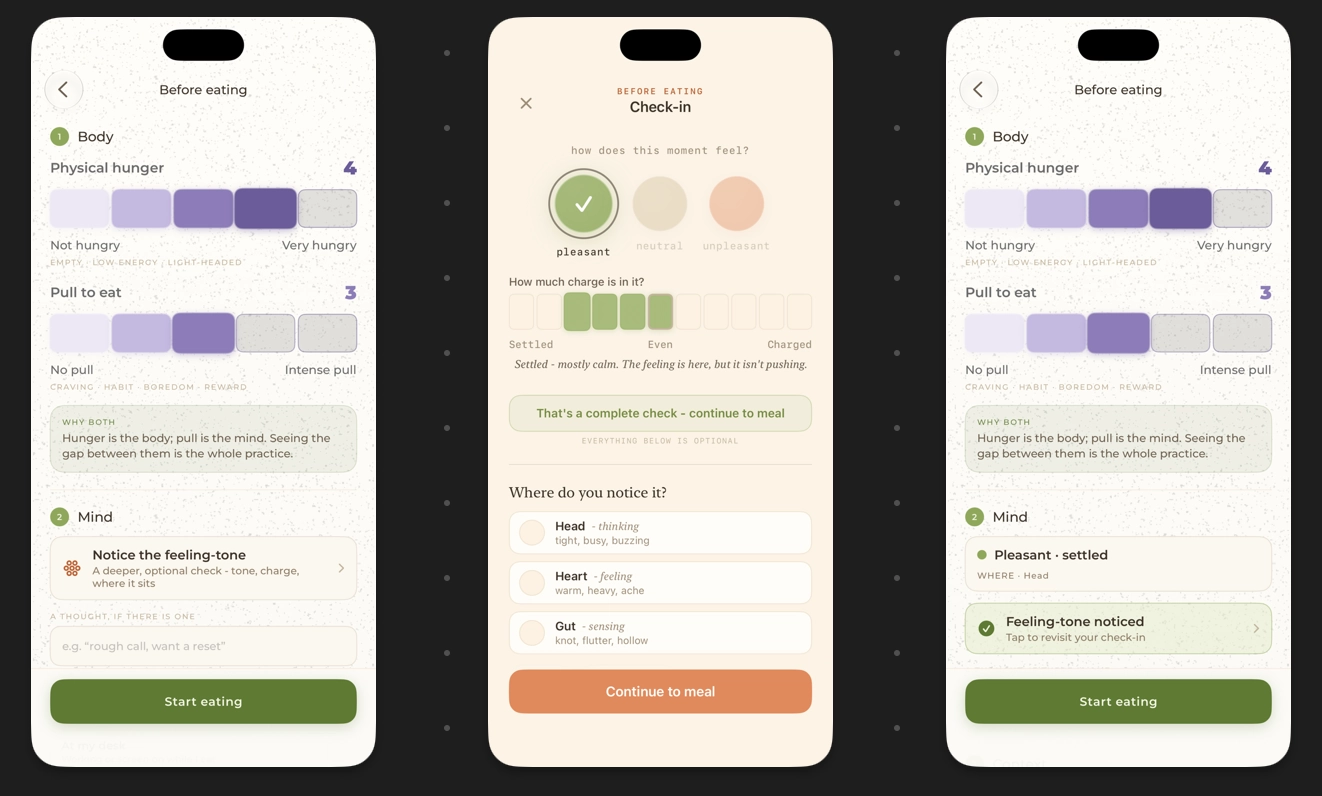
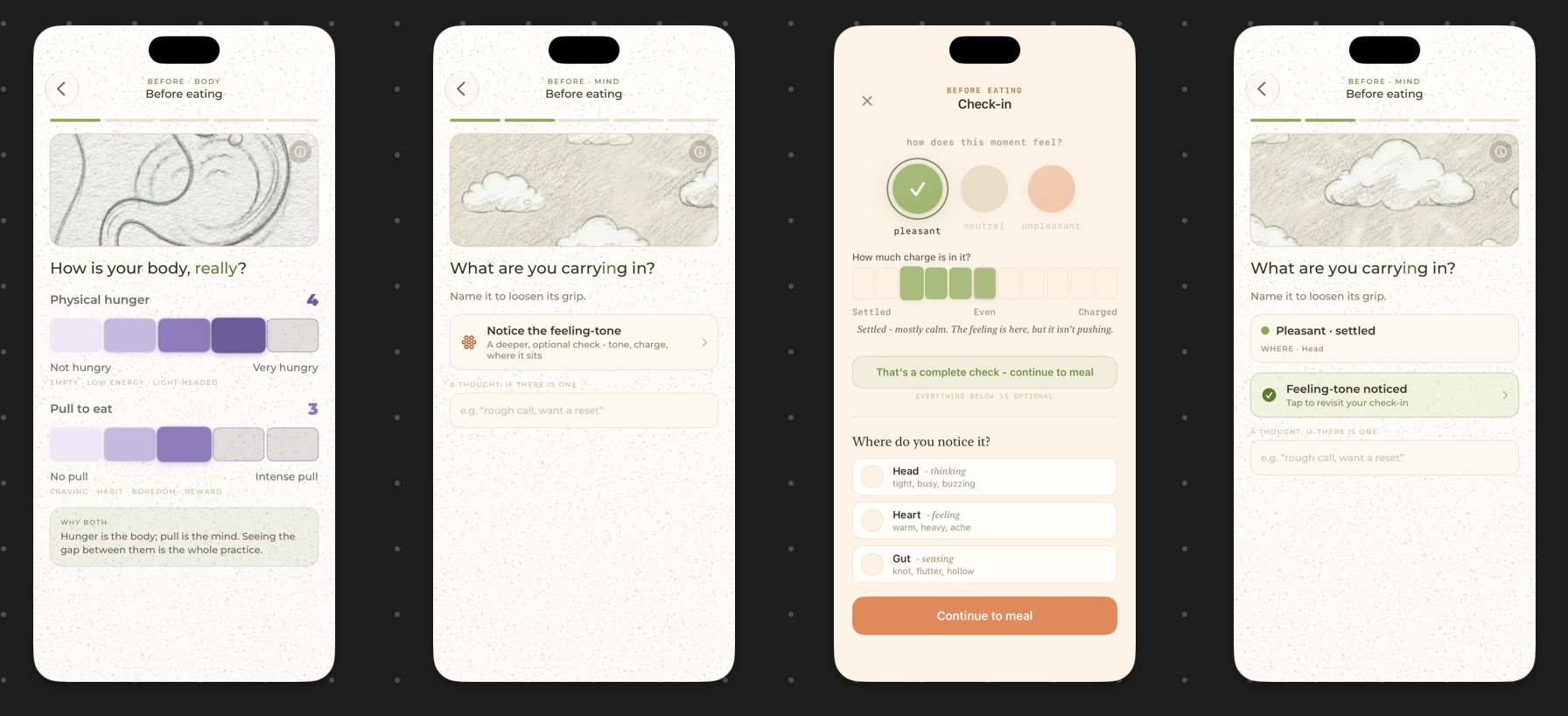
<p>Before we get to the questions the app asks (really, the questions we should be asking ourselves), one note. During development I experimented with how a meal should be logged, and two approaches survived. I called them Contemplative and Fast. The questions and steps are the same; only the interaction differs. Contemplative, the default, walks you through one card at a time. Fast puts everything on a single scrolling page. You choose in Settings.</p>

<p class="shots"><img src="/assets/pp_pause_startmeal.webp" alt="ProsoPlate's home screen and the Meal Flow setting: Contemplative or Fast" />
<img src="/assets/pp_pause_mealflow.webp" alt="ProsoPlate's pre-meal check-in: two meal flows" /></p>

<h2 id="three-questions-not-one">Three questions, not one</h2>

<p>I built the whole check-in around essentially three questions. The app asks about the body on one card and about the mind on the next, because the questions separate signals that usually arrive fused.</p>

<p>Hunger is your body’s signal. It builds slowly, sits low, and accepts any food. The pull is the craving signal. It arrives suddenly, sits high, and points at one exact thing. From the inside they can feel identical, so to see the difference it helps to measure them together, side by side.</p>

<p>And finally, the third question, what are you feeling, names the trigger. Most non-hunger eating starts in a state, not in a stomach: restless, flat, tired, relieved. Naming the state does not fix it. It does something smaller and more useful. It puts the state in front of you instead of behind you, where it was driving.</p>

<p>At the end of the check-in you can add a photo and a Promise score, and… start your meal. Nothing in the app is a rule about food. It is a rule about attention.</p>

<p class="shots"><img src="/assets/pp_pause_flow1.webp" alt="Fast flow: body and mind on one scrolling page, the optional feeling-tone check, then Start eating" />
<img src="/assets/pp_pause_flow2.webp" alt="Contemplative flow: body card, mind card, the optional feeling-tone check, mind card completed" /></p>

<h2 id="a-trial-that-measured-it">A trial that measured it</h2>

<p>And, to my surprise, those few small steps at the start of a meal turned out to work remarkably well for me. The truth is that at first I often forgot to reach for the app, and logged most meals after the fact. But after a few weeks, the pause before eating started to become part of every meal.</p>

<p>For the curious, here is what Dr. Brewer found with his own programme. His group tested app-delivered mindful eating with these ingredients. Ashley Mason and colleagues published the results in the <a href="https://pubmed.ncbi.nlm.nih.gov/28918456/">Journal of Behavioral Medicine</a> in 2018: 104 women with overweight or obesity, a 28-day self-paced smartphone programme built on the same reward-based learning model, with mindful eating practices aimed squarely at craving-related eating. Craving-related eating fell by about 40 percent, and three quarters of participants completed the programme.</p>

<p>With ProsoPlate I do it my own way, testing it on myself - and I am happy to say that it works for me.</p>

<h2 id="slow-is-the-feature">Slow is the feature</h2>

<p>So, back to where this article began: the checks stayed. If ProsoPlate ever feels slow in that moment before eating, good! Slow is the feature. The pause is the practice. The rest is a notebook.</p>

<p>You do not need the app to try it. Next time you are about to eat, ten seconds, three questions: how hungry, one to five; how strong the pull, one to five; what am I feeling, and is it pleasant or not. Then eat. You were going to eat anyway. But this time you looked first.</p>

<p>My goal is 80-82 kg, and there is still some way to go. Wish me luck, and all the best.</p>

<hr />

<p><em>ProsoPlate is available on the <a href="https://apps.apple.com/app/id6739646576">App Store</a> for £1.49. One purchase. No subscriptions. No ads.</em></p>

<p><em>prosoche.co - @father_bart</em></p>]]></content><author><name>Bart Smaga</name></author><category term="[&quot;mindful-eating&quot;]" /><category term="article" /><category term="prosoplate" /><category term="mindful-eating" /><summary type="html"><![CDATA[ProsoPlate's pre-meal questions look like data collection. They are the intervention - and there is a trial that measured it.]]></summary><media:thumbnail xmlns:media="http://search.yahoo.com/mrss/" url="https://prosoche.co/assets/pp_pause_og.jpg" /><media:content medium="image" url="https://prosoche.co/assets/pp_pause_og.jpg" xmlns:media="http://search.yahoo.com/mrss/" /></entry><entry><title type="html">ProsoStride is here</title><link href="https://prosoche.co/2026/prosostride-is-here/" rel="alternate" type="text/html" title="ProsoStride is here" /><published>2026-05-04T00:00:00+01:00</published><updated>2026-05-04T00:00:00+01:00</updated><id>https://prosoche.co/2026/prosostride-is-here</id><content type="html" xml:base="https://prosoche.co/2026/prosostride-is-here/"><![CDATA[<p>A year ago I started running again. Slowly. Embarrassingly slowly.</p>

<p>I had stopped, somewhere in my forties, the way people in their forties stop most things - gradually, then all at once. I came back not because I had decided to “get fit” again but because my resting heart rate was creeping up, my blood pressure with it, and the thing I was supposed to do for it was the thing I had stopped doing.</p>

<p>The instinct, when you start running again at 51, is to pretend you are still 25. Eight kilometres because eight kilometres used to be easy. Five-minute pace because five-minute pace used to be normal. The result, predictably, was a knee that did not want me to do this anymore and a chest that agreed.</p>

<p>So I switched approach. I had been reading about a Japanese method called Niko-Niko - “smile-pace” - where you go slow enough that you could hold a conversation, and you go consistently. Hiroaki Tanaka’s book sat on my bookshelf for two years before I actually read it. I should have read it sooner.</p>

<p>The premise is uncomfortable: most amateur endurance athletes train <em>too hard</em>. Not too little. Too hard. The polarised-training research suggests serious athletes spend ~80% of their time at low aerobic intensity and ~20% at high. Amateurs invert this - most of our training ends up in the medium-hard middle, which builds neither the aerobic base nor the high-end capacity. The fastest improvement available to most amateur runners, statistically, is <em>running more of their easy runs more easily</em>.</p>

<p>I found that, in practice, “running more of my easy runs more easily” was harder than it sounds. Heart rate lags. Pace fights uphills. Effort is hard to self-judge when you are already breathing. What worked, eventually, was <strong>cadence</strong> - the rate at which my feet hit the ground. If I held cadence in a tight band (around 175 steps per minute for slow jogging, around 110 for brisk walking), my speed self-regulated to whatever the slope demanded, my form held together, and I stayed under the heart-rate ceiling without thinking about it.</p>

<p>The two apps I tried for this didn’t quite do it. One had a metronome but did not listen to my actual cadence. The other tracked my cadence in retrospect - useful for a Sunday-evening review, useless during the run. Neither knew what Niko-Niko was. Neither respected that I just wanted a small audio cue when I drifted.</p>

<p>So I built <a href="/prosostride/">ProsoStride</a>.</p>

<h2 id="what-it-is">What it is</h2>

<p>It listens to your steps and gives you a quiet audio cue when you drift outside your cadence band. That’s it. That’s the feature.</p>

<p>The cadence band is personalised - to your age, optionally to your height, optionally to whether you want a “moderate” or “vigorous” target - using peer-reviewed research, not vibes. You can override every value. The research is the starting point; you are the editor.</p>

<p>It runs on the iPhone alone. Pop the phone in a pocket or armband, plug in earbuds, walk out the door. If you have an Apple Watch, pair it and you also get heart-rate zones based on Tanaka’s 138-minus-half-your-age formula. There is an interval timer for the days you fancy a structured session.</p>

<p>That is the app. There is no leaderboard. There is no “personal record”. There is no congratulatory animation when you finish. There is no subscription.</p>

<h2 id="what-v20-ships-today">What v2.0 ships today</h2>

<p>The earlier preview version (1.x) needed an Apple Watch for the core experience. Version 2.0 changes that. The biggest shifts:</p>

<ul>
  <li><strong>iPhone-only mode.</strong> Cadence guidance now works without a Watch. Apple’s CoreMotion pedometer carries the load.</li>
  <li><strong>Height-aware targets.</strong> If you opt in, the app uses your height (the Burns 2019 stature coefficient) to adjust your running cadence target. A 175-cm runner and a 195-cm runner do not need the same number.</li>
  <li><strong>Niko-Niko mode is the default.</strong> The earlier version had a complex 7-zone HR system as the default. Most people, including me, did not need that. The simpler 3-zone Niko-Niko system is now the front door; the 7-zone system is still in there for people who want it.</li>
  <li><strong>First-run experience rewritten.</strong> Age, height, intensity, four sliders - all on one screen, all explained, all override-able. You do not earn the ability to use the app.</li>
  <li><strong>Cadence Calculator</strong> in Settings, mirroring the existing HR Zone Calculator.</li>
</ul>

<p>The upgrade is free if you bought 1.x. There will be no v3.0 subscription.</p>

<h2 id="who-i-built-it-for">Who I built it for</h2>

<p>Two kinds of people, really:</p>

<ol>
  <li><strong>People who already know about Niko-Niko or Zone 2</strong> and want a tool that takes the methodology seriously instead of sticking it on a generic running app.</li>
  <li><strong>People who do not know any of that yet</strong>, but who suspect that whatever fitness tracker they tried last gave up on them. People who want to walk and jog at a pace their body actually likes.</li>
</ol>

<p>Both of those are me, at different points in the last few years.</p>

<h2 id="what-it-isnt">What it isn’t</h2>

<p>It isn’t a coach. It isn’t a training plan. It isn’t a “transformation” tool. It isn’t going to make you faster at racing.</p>

<p>What it can do, quietly: help you build an aerobic base, lower your resting heart rate, lower your blood pressure if it’s high, sleep better, and lose body fat slowly as a side effect. None of those are guaranteed. All of them are documented effects of consistent low-intensity cardio in middle-aged adults. My own n=1 data lines up with the literature, which surprises me less than I expected it to.</p>

<p>If you want to read the methodology in more depth, the <a href="/methods/niko-niko/">Niko-Niko methods page</a> is the longer version of this story.</p>

<h2 id="honest-disclaimers">Honest disclaimers</h2>

<ul>
  <li>I am not a physiologist. I read the research, build tools around it, and write honestly about what I find.</li>
  <li>The app is the cleanest implementation I could manage of work that researchers far better-credentialed than me have done. None of the methodology is mine. The faithful translation into an iPhone app is.</li>
  <li>If you have a heart condition, talk to your doctor before starting any new exercise practice. The Niko-Niko intensity is gentle, but “gentle” is not the same as “no clinical care needed”.</li>
</ul>

<h2 id="whats-next">What’s next</h2>

<p>I have shipped what I personally needed. The next things on my list:</p>

<ul>
  <li><strong>Polish localisation.</strong> I’m Polish; this is overdue.</li>
  <li><strong>Watch standalone mode.</strong> At the moment the iPhone is the primary device. I want a version where the Watch can run cadence solo.</li>
  <li><strong>Better recovery-day detection.</strong> The app currently doesn’t know when you’re tired. It should.</li>
  <li><strong>Optional Strava export</strong> for people who want it.</li>
</ul>

<p>If you have a feature request, drop me a line at <span class="prosoche-email" data-u="edirts-ih" data-d="oc.ehcosorp">hi-stride [at] prosoche [dot] co</span>
. I read everything.</p>

<p>The app is on the App Store now: <a href="https://apps.apple.com/app/id6475584820">ProsoStride</a>.</p>

<ul>
  <li>Bart</li>
</ul>

<hr />

<p><em>ProsoStride is available on the <a href="https://apps.apple.com/app/id6475584820">App Store</a>. One purchase. No subscription. No ads.</em></p>

<p><em>prosoche.co - @father_bart</em></p>]]></content><author><name>Bart Smaga</name></author><category term="[&quot;movement&quot;]" /><category term="dev" /><category term="article" /><category term="prosostride" /><category term="niko-niko" /><category term="movement" /><category term="launch" /><summary type="html"><![CDATA[Version 2.0 ships. iPhone-only mode is now real. A short note on why I built it and who it's for.]]></summary></entry><entry><title type="html">The Evening Review: Three Traditions, One Practice</title><link href="https://prosoche.co/2026/the-evening-review/" rel="alternate" type="text/html" title="The Evening Review: Three Traditions, One Practice" /><published>2026-03-21T00:00:00+00:00</published><updated>2026-03-21T00:00:00+00:00</updated><id>https://prosoche.co/2026/the-evening-review</id><content type="html" xml:base="https://prosoche.co/2026/the-evening-review/"><![CDATA[<p>Every evening, I sit with my phone for a few minutes and look at the day. Not doomscrolling. Looking at my data - the Mindful Awareness Timeline in <a href="/prosoplate/">ProsoPlate</a>. Cravings, meals, Pull ratings, Promise and Reality scores, the Gaps between what my brain predicted and what actually happened. A visual summary of one day’s relationship with food.</p>

<p>It is the most useful part of the practice, and I almost didn’t understand why.</p>

<h2 id="senecas-version">Seneca’s Version</h2>

<p>In <em>De Ira</em> (On Anger), Book 3, Chapter 36, Seneca describes his nightly self-examination:</p>

<p>“When the light has been removed and my wife has fallen silent, aware of this habit that’s now mine, I examine my entire day and go back over what I’ve done and said, hiding nothing from myself and passing nothing by. What bad habit have I cured today? What fault have I resisted? In what respect am I better?”</p>

<p>This is not journaling in the modern sense. It is not gratitude practice. It is honest self-examination - reviewing the day’s events with the specific intent of seeing what you missed while you were living it.</p>

<p>Seneca is explicit about the tone: it is that of an honest friend, not a judge. The purpose is to update self-knowledge, not to generate guilt. He describes himself as “his own censor” - a word that in Roman usage meant an examiner of conduct, not a punisher.</p>

<p>Marcus Aurelius practiced a complementary version: the morning anticipation. In <em>Meditations</em> 2.1, he prepares for the day by rehearsing what he will run into - the meddling, the ingratitude, the arrogance - so that none of it catches him unprepared. The morning is forward-looking preparation. The evening is backward-looking review. Between them, the day is bracketed by attention.</p>

<p>More on the <a href="/foundations/stoicism/">Stoic spiritual exercises</a> that Prosoche draws from.</p>

<h2 id="the-buddhist-version">The Buddhist Version</h2>

<p>The Pali tradition has its own form: paccavekkhana, reviewing one’s actions. In the Ambalatthika-rahulovada Sutta (MN 61), the Buddha tells his young son Rahula to look at every action after doing it, the way you check your face in a mirror: did it lead to harm, for me or for anyone else? If it did, own it and learn from it. If it did not, take quiet satisfaction and keep going. Not once a year. Every day, every action.</p>

<p>It is sati - mindfulness - applied retrospectively. You bring the same quality of honest, non-judgmental attention to the day’s events that you bring to the breath on the cushion. What happened? What did I notice? What did I miss?</p>

<p>The non-judgmental part matters. Both the Buddhist and Stoic traditions are clear: the evening review is not self-punishment. It is not the inner critic running the show. It is the practitioner looking at the day’s evidence with the same curiosity they would bring to watching a sunset - this is what happened, let me see it clearly.</p>

<h2 id="why-reflection-works-the-brains-update-mechanism">Why Reflection Works: The Brain’s Update Mechanism</h2>

<p>Dr. Judson Brewer’s research on reward-based learning offers a neuroscience explanation for why the evening review is not just philosophically nice but mechanistically important.</p>

<p>Brewer’s model shows that habits persist because of reward prediction - the brain expects a certain reward from a certain behavior, and that expectation drives the behavior. The prediction updates when the brain encounters prediction errors - moments where the expected reward doesn’t match the actual experience.</p>

<p>Here is my reading of it - and I should flag that this is my extrapolation, not something Brewer claims: the prediction doesn’t always update in the moment. During the experience itself, especially a strongly craved one, the anticipation is loud enough to drown out the discrepancy.</p>

<p>A good deal of the update happens later, in reflection. When you sit with the day’s data and see that the 3pm biscuit - rated a 9 for Promise - consistently lands at a 4 for Reality, the brain has time to process that discrepancy without the craving’s interference. The pattern becomes visible. The prediction quietly adjusts.</p>

<p>This is why ProsoPlate’s Mindful Awareness Timeline is designed as an evening tool. Not because you need to check your stats at 9pm, but because the evening is when there is finally enough distance from the craving to see it. For me, the review is where the day’s noticing lands.</p>

<h2 id="what-i-see">What I See</h2>

<p>When I look at my Timeline at the end of the day, I notice things I missed in the moment:</p>

<p>The 4pm craving was a 7 for Pull, but I wasn’t hungry - my hunger was a 2. That craving was emotional, not physical. I didn’t see that at 4pm. I see it now.</p>

<p>The lunch I barely thought about - a Promise of 5 - turned out to be a Reality of 7. Positive Gap. The meal I didn’t crave was more satisfying than the one I desperately wanted. That pattern has been repeating for weeks.</p>

<p>The 9pm snack: Pull was a 6, Promise was a 7, Reality was a 3. Negative Gap of -4. The brain predicted reward that did not arrive. I don’t need to decide not to have that snack tomorrow. The data is doing something more honest than my willpower ever could - it is teaching my brain that the prediction is wrong.</p>

<p>None of this is visible in the moment. All of it is visible in the review.</p>

<h2 id="the-practice">The Practice</h2>

<p>Five minutes. End of day. Look at what happened.</p>

<p>If you use ProsoPlate, the Timeline does the work of surfacing the patterns. If you don’t, you can still practice the evening review. Three questions, borrowed from Seneca:</p>

<ol>
  <li>What did I eat that I didn’t plan to? (Not to judge - to notice)</li>
  <li>Where was the biggest gap between what I expected and what I got?</li>
  <li>What was I actually feeling when the strongest craving hit?</li>
</ol>

<p>Write it down or don’t. The important part is the looking. The honest, non-punitive looking.</p>

<p>Three traditions arrived at the same practice: Stoic self-examination, Buddhist paccavekkhana, and modern reward-based learning all say the same thing. The brain needs time to process what happened. Give it that time. The awareness that you missed during the day lands during the review.</p>

<hr />

<p><em>ProsoPlate is available on the <a href="https://apps.apple.com/app/id6739646576">App Store</a> for £1.49. One purchase. No subscriptions. No ads.</em></p>

<p><em>prosoche.co - @father_bart</em></p>]]></content><author><name>Bart Smaga</name></author><category term="[&quot;reflections&quot;]" /><category term="article" /><category term="prosoplate" /><category term="reflections" /><summary type="html"><![CDATA[Every evening, I sit with my phone for a few minutes and look at the day. Not doomscrolling. Looking at my data - the Mindful Awareness Timeline in ProsoPlate. Cravings, meals, Pull ratings, Promise and Reality scores, the Gaps between what my brain predicted and what actually happened. A visual summary of one day’s relationship with food.]]></summary></entry><entry><title type="html">Interoception: The Skill Nobody Taught You</title><link href="https://prosoche.co/2026/interoception/" rel="alternate" type="text/html" title="Interoception: The Skill Nobody Taught You" /><published>2026-03-20T00:00:00+00:00</published><updated>2026-03-20T00:00:00+00:00</updated><id>https://prosoche.co/2026/interoception</id><content type="html" xml:base="https://prosoche.co/2026/interoception/"><![CDATA[<p>There’s a skill that affects how you eat, how you manage stress, how well you read your own emotions, and how accurately you know when to stop - and nobody taught it to you. Most people have never heard the word for it.</p>

<p>Interoception is the ability to accurately sense what’s happening inside your own body. Not just pain - the whole internal landscape. Heart rate, breath, muscle tension, gut signals, the subtle cues that distinguish hunger from anxiety, tiredness from sadness, genuine appetite from habit.</p>

<p>You would think this would be automatic. It is not.</p>

<h2 id="what-the-research-shows">What the Research Shows</h2>

<p>Lisa Feldman Barrett, a neuroscientist at Northeastern University, has built a career around a radical finding: emotions are not hard-wired circuits that fire automatically. They are constructed by the brain from two primitive ingredients - valence (pleasant/unpleasant) and arousal (activated/deactivated). The brain takes these raw body signals, combines them with context and past experience, and constructs what we call “emotion.”</p>

<p>In <em>How Emotions Are Made</em> (2017), Barrett shows that the accuracy of this construction depends directly on interoceptive accuracy - how well you can read the raw body signals in the first place. People with poor interoceptive accuracy confuse hunger for anxiety. They eat when they’re bored because they can’t distinguish boredom from appetite. They reach for comfort food when the actual signal is fatigue. The body is sending useful information. They just can’t read it.</p>

<p>Sahib Khalsa and colleagues at the Laureate Institute for Brain Research published a 2018 review showing that disrupted interoceptive processing is a feature of anxiety disorders, eating disorders, and depression. The body keeps signaling. The signal keeps getting misread or ignored.</p>

<p>The implication is uncomfortable: most of us have spent decades training ourselves to not feel our bodies. We eat on schedules, not hunger. We override tiredness with caffeine. We sit for hours without noticing the accumulated tension. Interoceptive accuracy is a skill, and like any skill, it atrophies without use.</p>

<h2 id="the-hunger-check">The Hunger Check</h2>

<p>This is why <a href="/prosoplate/">ProsoPlate’s</a> pre-meal hunger check matters more than it looks.</p>

<p>Before every meal, the app asks: “How hungry are you right now?” You rate it on a scale. Three seconds, and nothing about it looks like training.</p>

<p>It is. It is interoception training, done at the only moment it can be done - right before you eat.</p>

<p>Every time you pause before eating and honestly ask “Am I actually hungry?” you are doing something the brain needs practice with: turning attention inward, reading the body’s signals, and distinguishing hunger from its many imposters.</p>

<p>Am I hungry, or am I stressed? The body feels different in each case, but if you haven’t practiced noticing the difference, they both just feel like “I need something.” Am I hungry, or am I bored? Boredom has a restless quality - a desire for stimulation, not nourishment. But if your interoceptive accuracy is low, both drive you toward the fridge.</p>

<p>The hunger check builds this discrimination skill one meal at a time. Not by teaching you the difference intellectually - you already know the difference - but by making you practice noticing it in the moment.</p>

<p>In the version 1.5 release notes, I wrote that the pre-meal checks “are the intervention, not data collection.” I almost removed them because they looked like friction. They looked like extra taps before eating. What I didn’t understand at first was that those taps are the mechanism. The pause, the inward turn, the honest reading of the body - that IS the Clarity Method in action. Removing them would have broken the app.</p>

<h2 id="the-buddhist-connection">The Buddhist Connection</h2>

<p>The first foundation of mindfulness in the <a href="/foundations/satipatthana/">Satipatthana</a> framework is kayanupassana - contemplation of the body. This is literally what interoception training does: turning attention toward bodily experience with sustained, non-judgmental awareness.</p>

<p>The Satipatthana Sutta describes the practitioner observing the body “in the body” - not thinking about the body from the outside, but feeling it from the inside. Breath, posture, physical sensations, the arising and passing of bodily phenomena. This 2,500-year-old practice instruction is, in modern terms, systematic interoception training.</p>

<p>The second foundation - <a href="/foundations/vedananupassana/">vedananupassana</a> - takes this further. Vedana (feeling tone) is the affective quality of bodily experience: pleasant, unpleasant, or neutral. When the hunger check reveals that the “hunger” you thought you felt is actually anxiety, what you’ve done is distinguish two different vedana - two different feeling tones that were previously being fused into one undifferentiated urge. That’s vedananupassana in practice.</p>

<h2 id="how-to-start">How to Start</h2>

<p>You do not need an app or a meditation practice to begin rebuilding interoceptive accuracy. You need to start asking your body questions and waiting for the answers.</p>

<p><strong>Before eating:</strong> Pause. Put your hand on your stomach if it helps. Ask: “Am I hungry?” Don’t answer from your head. Wait for the body to respond. You may notice genuine stomach hunger - an emptiness, a lightness. Or you may notice something else - tension in the shoulders, a jittery restlessness, a flatness that is closer to boredom than appetite. Whatever you notice is the right answer. There are no wrong body signals, only unnoticed ones.</p>

<p><strong>During the day:</strong> Two or three times, stop and scan. What does your body feel like right now? Not “what should I be feeling” - what is actually there? Tight jaw? Held breath? Heavy limbs? Light energy? This is not meditation. It is a five-second check-in. Over time, these check-ins bring back a sensitivity that years of not looking have dulled.</p>

<p><strong>After eating:</strong> Fifteen minutes after a meal (ProsoPlate calls this the Clarity Check), ask: “How does my body feel now?” This is when the initial dopamine rush of eating has faded and the actual effects of the food become perceptible. Energized or sluggish? Satisfied or still wanting? Light or heavy? The body knows. You just have to listen.</p>

<h2 id="the-skill-that-runs-underneath">The Skill That Runs Underneath</h2>

<p>Interoception is not a mindfulness technique. It is the substrate that mindfulness techniques depend on. You cannot practice the <a href="/methods/clarity-method/">Clarity Method</a> without reading your body. You cannot do <a href="/methods/rain/">RAIN</a> - the Investigate step, where you explore bodily sensations - without interoceptive access. You cannot run at <a href="/methods/niko-niko/">Niko-Niko</a> pace without sensing whether your body is smiling or grimacing.</p>

<p>Barrett’s research suggests that improving interoceptive accuracy improves emotional regulation, decision-making, and self-awareness across the board - not just around eating. The hunger check is the entry point. The skill it builds extends everywhere.</p>

<p>Nobody taught you this skill. That is not your fault. You can start rebuilding it today, one honest body check at a time.</p>

<hr />

<p><em>ProsoPlate is available on the <a href="https://apps.apple.com/app/id6739646576">App Store</a> for £1.49. One purchase. No subscriptions. No ads.</em></p>

<p><em>prosoche.co - @father_bart</em></p>]]></content><author><name>Bart Smaga</name></author><category term="[&quot;mindful-eating&quot;]" /><category term="article" /><category term="prosoplate" /><category term="mindful-eating" /><summary type="html"><![CDATA[There’s a skill that affects how you eat, how you manage stress, how well you read your own emotions, and how accurately you know when to stop - and nobody taught it to you. Most people have never heard the word for it.]]></summary></entry><entry><title type="html">Why I Don’t Count Calories (And What I Track Instead)</title><link href="https://prosoche.co/2026/why-i-dont-count-calories/" rel="alternate" type="text/html" title="Why I Don’t Count Calories (And What I Track Instead)" /><published>2026-03-18T00:00:00+00:00</published><updated>2026-03-18T00:00:00+00:00</updated><id>https://prosoche.co/2026/why-i-dont-count-calories</id><content type="html" xml:base="https://prosoche.co/2026/why-i-dont-count-calories/"><![CDATA[<p>I spent years counting calories. I was good at it - spreadsheets, apps, weighed portions. I knew the macros on a chicken breast without looking. And every time I stopped counting, the weight came back.</p>

<p>That cycle has a name. Traci Mann’s team at UCLA published a meta-analysis in 2007 that reviewed every long-term study of calorie-restricted dieting they could find. Their conclusion: one-third to two-thirds of dieters regain more weight than they lost. The weight loss is real. The weight loss lasting is not. Restriction works in the short term. It fails in the long term because it does not change the brain’s relationship with food.</p>

<p>A.J. Tomiyama’s 2010 study (University of California, San Francisco) showed why: calorie restriction increases cortisol production. The body interprets restriction as a threat. Cortisol drives you toward calorie-dense foods. The harder you restrict, the louder the body screams for exactly the foods you are restricting. You are not failing because you lack willpower. You are failing because the strategy creates its own opposition.</p>

<h2 id="the-alternative">The Alternative</h2>

<p>Dr. Judson Brewer at Brown University has spent two decades studying a different approach. Instead of restricting what people eat, his research focuses on bringing awareness to the eating experience itself. His clinical trials on smokers, emotional eaters, and anxious patients consistently show the same result: when people observe their experience with honest curiosity rather than trying to control it, the brain’s reward predictions update themselves.</p>

<p>Brewer’s framework distinguishes between <strong>restriction-based approaches</strong> (calorie counting, food rules, elimination diets) and <strong>awareness-based approaches</strong> (mindful attention to what actually happens when you eat). The restriction approach fights the habit loop from outside with willpower. The awareness approach disrupts the loop from inside by updating the brain’s reward model.</p>

<p>The mechanism is reward prediction error. Your brain predicts that the biscuit will be a 9 out of 10. You eat it with full attention. It is actually a 5. That gap between prediction and reality - the prediction error - is the signal that causes the brain to downgrade its reward estimate. Do this enough times and the craving weakens. Not because you said no. Because the brain learned the truth.</p>

<h2 id="what-prosoplate-tracks">What ProsoPlate Tracks</h2>

<p>When I built <a href="/prosoplate/">ProsoPlate</a>, I needed to decide what to measure. Calories were out. Here is what stayed and why:</p>

<p><strong>Hunger (before eating)</strong> - “How hungry am I, actually, right now?” This is interoception training. Lisa Feldman Barrett’s research on constructed emotion shows that people with poor interoceptive accuracy - the ability to accurately read signals from inside their own body - are worse at distinguishing hunger from anxiety, boredom from appetite. Every time you pause and honestly rate your hunger, you are rebuilding a skill that most adults have let atrophy. The hunger check is not data. It is practice.</p>

<p><strong>Pull (before eating)</strong> - “How strong is the craving right now?” This creates cognitive defusion. Steven Hayes and Russ Harris (ACT - Acceptance and Commitment Therapy) showed that the moment you observe a craving as a craving - rather than being fused with it - its behavioral power decreases. The Pull rating is a one-second defusion exercise. More on this in <a href="/2026/the-pull/">The Pull: What Craving Actually Feels Like When You Watch It</a>.</p>

<p><strong>Promise (before eating)</strong> - “How rewarding do I expect this to be?” This captures the brain’s reward prediction. It is the baseline that makes the prediction error visible. Without the Promise, you have no measure of what the brain was selling you.</p>

<p><strong>Reality (after eating)</strong> - “How rewarding was that, actually?” This is the honest assessment. One number, on a bipolar scale from -5 to +5. When you sit with this question, you are already checking your body, scanning for satisfaction, noticing if the experience matched the anticipation. The number IS the summary.</p>

<p><strong>The Gap</strong> - The difference between Promise and Reality. ProsoPlate calculates this automatically. When the Gap is negative - when Reality was less rewarding than Promise predicted - that is Brewer’s reward prediction error, visible and trackable. Repeated negative Gaps for the same type of food erode the craving over time. You don’t have to decide not to eat it. The brain quietly stops overselling it.</p>

<h2 id="what-changed">What Changed</h2>

<p>When I stopped counting calories and started tracking awareness, two things happened.</p>

<p>First, meals got simpler. I wasn’t optimizing for macros anymore. I was paying attention to what my body actually wanted and what actually satisfied it. Foods I used to crave because they were “off-limits” lost their forbidden-fruit charge. Foods I used to ignore because they were “just vegetables” turned out to be genuinely satisfying when I actually tasted them.</p>

<p>Second, the data told a different story. The Mindful Awareness Timeline - ProsoPlate’s evening review - showed me patterns that calorie counting never could. Peak craving times. Emotional triggers. The foods where the Gap was consistently negative, meaning my brain kept overselling them despite repeated evidence. You can know intellectually that the biscuit isn’t worth it. Seeing a month of negative Gap scores next to photos of the same biscuit does something different. It updates the knowledge from the head to the gut.</p>

<h2 id="the-evidence-not-the-theory">The Evidence, Not the Theory</h2>

<p>I’m not arguing against calorie awareness as a concept. Understanding roughly what you’re eating has value. What I’m arguing against is calorie counting as a behavior change strategy - the idea that if you just track the numbers precisely enough, your behavior will change. Mann’s meta-analysis, Tomiyama’s cortisol research, and Brewer’s clinical trials all point in the same direction: restriction-based approaches fail in the long term because they do not address the mechanism that drives the behavior.</p>

<p>Awareness-based approaches address the mechanism directly. The <a href="/methods/clarity-method/">Clarity Method</a> - Promise, Reality, Gap - is Brewer’s reward prediction error made practical. It works not because it tells you what to eat, but because it helps you see what is actually happening when you eat.</p>

<p>That turns out to be enough.</p>

<hr />

<p><em>ProsoPlate is available on the <a href="https://apps.apple.com/app/id6739646576">App Store</a> for £1.49. One purchase. No subscriptions. No ads.</em></p>

<p><em>prosoche.co - @father_bart</em></p>]]></content><author><name>Bart Smaga</name></author><category term="[&quot;mindful-eating&quot;]" /><category term="article" /><category term="prosoplate" /><category term="mindful-eating" /><summary type="html"><![CDATA[I spent years counting calories. I was good at it - spreadsheets, apps, weighed portions. I knew the macros on a chicken breast without looking. And every time I stopped counting, the weight came back.]]></summary></entry><entry><title type="html">The Pull: What Craving Actually Feels Like When You Watch It</title><link href="https://prosoche.co/2026/the-pull/" rel="alternate" type="text/html" title="The Pull: What Craving Actually Feels Like When You Watch It" /><published>2026-03-16T00:00:00+00:00</published><updated>2026-03-16T00:00:00+00:00</updated><id>https://prosoche.co/2026/the-pull</id><content type="html" xml:base="https://prosoche.co/2026/the-pull/"><![CDATA[<p>Before every meal, <a href="/prosoplate/">ProsoPlate</a> asks you to rate one thing: the Pull. On a scale of zero to ten, how strong is the craving right now?</p>

<p>It takes two seconds. It looks like data collection. It is not.</p>

<p>That two-second pause is the entire intervention.</p>

<h2 id="what-happens-in-the-brain">What Happens in the Brain</h2>

<p>Dr. Judson Brewer’s research at Brown University has mapped what craving looks like in the brain using real-time fMRI. When people experience cravings - for cigarettes, food, or the urge to check their phone - the posterior cingulate cortex (PCC) lights up. The PCC is a hub of the default mode network, the system that activates when the mind wanders into self-referential thinking: “I want this,” “I need this,” “I deserve this.”</p>

<p>Here is the interesting part. When experienced meditators observe their cravings with mindful awareness rather than acting on them, PCC activity decreases. The craving literally has less neural power when it is being watched. This is not willpower suppressing the craving from above. This is the craving losing its grip because it is being seen clearly (Brewer et al., 2011, Proceedings of the National Academy of Sciences).</p>

<p>Brewer’s subsequent clinical work showed that this mechanism - mindful awareness reducing PCC-mediated craving - produced outcomes five times better than standard cognitive behavioral treatment for smokers. Not because the participants tried harder. Because they observed more honestly.</p>

<h2 id="what-it-feels-like">What It Feels Like</h2>

<p>I’ve rated the Pull before hundreds of meals now. Here is what I’ve noticed.</p>

<p>When the Pull is low - a 2 or 3 - it barely registers. You’re eating because it’s time to eat. The food is there. You sit down. There’s no story, no urgency.</p>

<p>When the Pull is high - a 7, 8, 9 - it is physical. There’s a tightness in the chest, a forward lean, a narrowing of attention onto the food. The mind starts negotiating: “You earned this.” “Just this once.” “You’ll be good tomorrow.” The body wants to move toward the food before the mind has finished deciding.</p>

<p>The moment you rate it - the moment you stop and put a number on it - something shifts. You step back from the craving and look at it. In ACT terms (Steven Hayes, Russ Harris), this is cognitive defusion: you are no longer fused with the craving, identified with it, driven by it. You are the person noticing the craving. The craving is a weather pattern passing through. It is not you.</p>

<p>This is what the Buddhist tradition calls <a href="/foundations/vedananupassana/">vedananupassana</a> - watching the feeling tone (pleasant, unpleasant, neutral) without adding to it. The pleasant pull toward food is vedana. Noticing it as vedana, rather than living inside it, interrupts the chain between feeling and reaction.</p>

<h2 id="what-to-do-when-the-pull-is-a-9">What to Do When the Pull Is a 9</h2>

<p>Nothing heroic. You don’t fight it. You don’t suppress it. You observe it.</p>

<p>Rate it honestly. Notice where in the body you feel it. Notice the stories your mind is telling - the justifications, the promises, the urgency. You can even use the <a href="/methods/rain/">RAIN practice</a> if the craving feels overwhelming: Recognize it, Allow it to be there, Investigate what it feels like in the body, and Nurture yourself with a moment of self-compassion.</p>

<p>Then eat. You were going to eat anyway. But now you’ve inserted a moment of honest awareness between the craving and the action. That moment is where the <a href="/methods/clarity-method/">Clarity Method</a> does its work.</p>

<p>After the meal, when ProsoPlate asks you to rate Reality - “How rewarding was that, actually?” - the brain gets to compare its prediction (the Pull, the Promise) against the actual experience. When the food doesn’t deliver what the craving promised, the brain’s reward prediction machinery updates itself. Over time, the same food generates less Pull. Not because you restricted it. Because you saw through it.</p>

<h2 id="the-smallest-possible-practice">The Smallest Possible Practice</h2>

<p>You don’t need an app to do this. The next time you sit down to eat and feel that pull - the urgency, the anticipation, the “I need this” - pause for one breath and ask: “How strong is this pull, on a scale of zero to ten?”</p>

<p>That’s it. One number. One breath. One moment of seeing the craving as a craving rather than living inside it.</p>

<p>The craving doesn’t disappear. It just stops running the show.</p>

<hr />

<p><em>ProsoPlate is available on the <a href="https://apps.apple.com/app/id6739646576">App Store</a> for £1.49. One purchase. No subscriptions. No ads.</em></p>

<p><em>prosoche.co - @father_bart</em></p>]]></content><author><name>Bart Smaga</name></author><category term="[&quot;mindful-eating&quot;]" /><category term="article" /><category term="prosoplate" /><category term="mindful-eating" /><summary type="html"><![CDATA[Before every meal, ProsoPlate asks you to rate one thing: the Pull. On a scale of zero to ten, how strong is the craving right now?]]></summary></entry><entry><title type="html">Version 1.5 - Less Friction, More Seeing</title><link href="https://prosoche.co/2026/prosoplate-version-1-5/" rel="alternate" type="text/html" title="Version 1.5 - Less Friction, More Seeing" /><published>2026-03-14T00:00:00+00:00</published><updated>2026-03-14T00:00:00+00:00</updated><id>https://prosoche.co/2026/prosoplate-version-1-5</id><content type="html" xml:base="https://prosoche.co/2026/prosoplate-version-1-5/"><![CDATA[<p>I almost over-engineered my own app.</p>

<p>ProsoPlate started with a simple idea: track what food promises your brain, then track what it actually delivers. The Gap between the two does the work. Not willpower. Not discipline. Just honest observation, repeated over time. That’s Dr. Judson Brewer’s reward prediction error research applied to your lunch.</p>

<p>But somewhere between version 1.0 and version 1.4, I kept adding. More questions. More inputs. More data points after every meal. Ten separate things to tap before you could put your phone down and get on with your life. I built a contemplative app that was starting to feel like a tax return.</p>

<p>So version 1.5 is mostly about what I removed.</p>

<h2 id="the-post-meal-flow-is-shorter-now">The Post-Meal Flow Is Shorter Now</h2>

<p>Here’s what Brewer’s research at Brown University actually requires for the disenchantment mechanism to work: you need to pay careful attention to the eating experience, and then honestly rate how rewarding it was. That’s it. The Reality score - your single -5 to +5 rating of “How rewarding was that, really?” - is already an integrated assessment. When you sit with that question for a moment, you’re already checking your body, noticing your emotional state, scanning for satisfaction or regret. The number IS the summary.</p>

<p>I had been asking people to do that assessment AND separately rate fullness, AND tag body sensations, AND tag emotional weather, AND write free-text insights. All immediately after eating. That’s not mindfulness - that’s data entry.</p>

<p>Version 1.5 strips the post-meal moment back to what matters: The Reality. One honest number. The body investigation moves to the 15-minute Clarity Check, which is where the science says it belongs anyway - that’s when the initial dopamine rush has faded and you can actually feel what the food did to you.</p>

<p>Fewer taps. Same mechanism. The intervention is the attention, not the form-filling.</p>

<h2 id="what-i-didnt-remove">What I Didn’t Remove</h2>

<p>The pre-meal steps - Hunger check and Pull rating - those stay. I considered cutting them too. They looked like data collection. They’re not.</p>

<p>The Hunger check trains interoceptive accuracy. That’s your ability to accurately read signals from inside your own body. Lisa Feldman Barrett’s research on constructed emotion shows that people with poor interoceptive accuracy are worse at regulating their emotional states - they literally can’t tell the difference between hunger, anxiety, and boredom. Every time you pause before eating and honestly ask “How hungry am I, actually?” you’re training a skill that most adults have let atrophy.</p>

<p>The Pull rating - “How strong is the craving right now?” - creates a moment of cognitive defusion. In ACT terms (Steven Hayes, Russ Harris), you’re stepping back from the craving and observing it rather than being fused with it. You’re not the craving. You’re the person noticing the craving. That two-second shift changes everything downstream.</p>

<p>So the pre-meal checks aren’t friction. They’re the intervention. Removing them would have broken the app’s core mechanism. I’m glad I caught that before shipping.</p>

<h2 id="multiple-photos-per-meal">Multiple Photos Per Meal</h2>

<p>Small change, obvious in hindsight. You can now capture more than one photo per meal - and quick-log items (snacks, drinks, that biscuit) get photos too.</p>

<p>Why this matters: the photo isn’t for Instagram. It’s for your evening review. When you sit with your Mindful Awareness Timeline at the end of the day and see the actual plate next to your Promise and Reality scores, something clicks. Visual memory is stronger than numerical memory. You don’t remember what you rated that Tuesday lunch. You remember the plate.</p>

<h2 id="the-mindful-awareness-timeline">The Mindful Awareness Timeline</h2>

<p>This got the most attention in 1.5. The timeline - where your whole day is laid out with cravings, meals, gaps, and patterns - has been redesigned to be more informative and more pleasant to use.</p>

<p>I won’t pretend there’s a dramatic story here. I looked at my own data every evening for months. Some things were hard to read. Some patterns were invisible because the layout didn’t surface them clearly. I fixed the things that bothered me as a daily user. That’s it.</p>

<p>The evening review is where the Clarity Method actually lands. Brewer’s research shows that real-time awareness during eating starts the process, but the consolidation - the moment where your brain actually updates its predictions - happens during reflection. When you see a week of Gap scores trending negative for the same food, you don’t need anyone to tell you what’s happening. You just… see it.</p>

<h2 id="the-redesigned-start-meal-and-log-meal-flow">The Redesigned Start Meal and Log Meal Flow</h2>

<p>The whole flow from “I’m about to eat” to “I’m done” has been tightened. Fewer screens. Cleaner transitions. The same contemplative micro-practices - Hunger, Pull, Promise, photo, eat, Reality, Gap - but with less friction between them.</p>

<p>I removed dark mode entirely. It didn’t work well with the violet-teal palette and it was doubling my design work for marginal benefit. One clean, light interface. Done.</p>

<h2 id="what-hasnt-changed">What Hasn’t Changed</h2>

<p>The Clarity Method is the same. Promise before eating. Reality after. The Gap reveals what your brain oversold. Repeated honest observation erodes the false reward predictions over time - not through willpower, but through the same mechanism that Brewer documented in his clinical trials with smokers and emotional eaters.</p>

<p>Still no subscriptions. Still £1.49. Still no accounts, no cloud, no one looking at your data. Everything stays on your device.</p>

<p>Still built by a 52-year-old father in London who needed this tool himself and has lost weight using it.</p>

<h2 id="one-thing-ive-learned">One Thing I’ve Learned</h2>

<p>The hardest part of building a contemplative app is resisting the urge to add more. More features, more data, more insights, more cleverness. The whole philosophical foundation - Satipatthana, Stoicism, ACT - points in the same direction: pay attention to what’s actually here. Not more. Not better. Just clearer.</p>

<p>Version 1.5 is ProsoPlate getting out of its own way.</p>

<hr />

<p><em>ProsoPlate is available on the <a href="https://apps.apple.com/app/id6739646576">App Store</a> for £1.49. One purchase. No subscriptions. No ads.</em></p>

<p><em>prosoche.co · @father_bart</em></p>]]></content><author><name>Bart Smaga</name></author><category term="[&quot;mindful-eating&quot;]" /><category term="dev" /><category term="article" /><category term="prosoplate" /><category term="release" /><summary type="html"><![CDATA[I almost over-engineered my own app.]]></summary></entry><entry><title type="html">Version 1.2 - One Question at a Time</title><link href="https://prosoche.co/2026/prosoplate-version-1-2/" rel="alternate" type="text/html" title="Version 1.2 - One Question at a Time" /><published>2026-02-04T00:00:00+00:00</published><updated>2026-02-04T00:00:00+00:00</updated><id>https://prosoche.co/2026/prosoplate-version-1-2</id><content type="html" xml:base="https://prosoche.co/2026/prosoplate-version-1-2/"><![CDATA[<p>Version 1.2 is a small release with a slightly odd result: the meal flow has more steps than before, and it feels simpler.</p>

<hr />

<h3 id="one-question-per-screen">One question per screen</h3>

<p>Until now, starting a meal put everything on one screen - hunger, body sensations, intention, photo - and asked you to fill it in like a form. It worked, but it looked like work, and I caught myself skimming it. Skimming is the opposite of what the pre-meal pause is for.</p>

<p>So each question now gets its own screen and its own moment:</p>

<ul>
  <li>Hunger check</li>
  <li>Body sensations</li>
  <li>Pre-meal intention</li>
  <li>Photo</li>
</ul>

<p>More taps, yes. But one question at a time turns out to be faster, because there is nothing else on the screen to parse. You answer, you move on. And, more to the point, you actually read the question.</p>

<hr />

<h3 id="snacks-and-drinks-are-visible-now">Snacks and drinks are visible now</h3>

<p>Quick snack and drink logs used to be recorded and then disappear - in the history, but nowhere on the home screen. Now the morning coffee, the afternoon biscuit and the “just one crisp” moment all show up in Today’s Meals, alongside the proper meals.</p>

<p>This matters more than it sounds. Half of my eating isn’t meals. It is the stuff in between, and if I can’t see it, I can’t notice any pattern in it. A day now looks like an actual day: breakfast, coffee, snack, lunch, snack, dinner, a glass of wine. Not just the three sit-down events.</p>

<hr />

<h3 id="thats-the-update">That’s the update</h3>

<p>Two changes: a roomier meal flow, and snacks and drinks out in the open. Both belong to the category of “obviously it should have always been like that”, which is usually the sign of a good change.</p>

<p>See you in 1.3.</p>

<hr />

<p><em>ProsoPlate 1.2 is on the <a href="/prosoplate/">App Store</a>.</em></p>]]></content><author><name>Bart Smaga</name></author><category term="[&quot;mindful-eating&quot;]" /><category term="dev" /><category term="article" /><category term="prosoplate" /><category term="release" /><summary type="html"><![CDATA[Version 1.2 is a small release with a slightly odd result: the meal flow has more steps than before, and it feels simpler.]]></summary></entry><entry><title type="html">Emotions, Timing, and the Awareness Timeline</title><link href="https://prosoche.co/2026/prosoplate-january-release/" rel="alternate" type="text/html" title="Emotions, Timing, and the Awareness Timeline" /><published>2026-01-20T00:00:00+00:00</published><updated>2026-01-20T00:00:00+00:00</updated><id>https://prosoche.co/2026/prosoplate-january-release</id><content type="html" xml:base="https://prosoche.co/2026/prosoplate-january-release/"><![CDATA[<p>Today’s ProsoPlate update brings three interconnected features that deepen how you can observe your eating patterns. Each one emerged from research and from my own experience using the app daily.</p>

<hr />

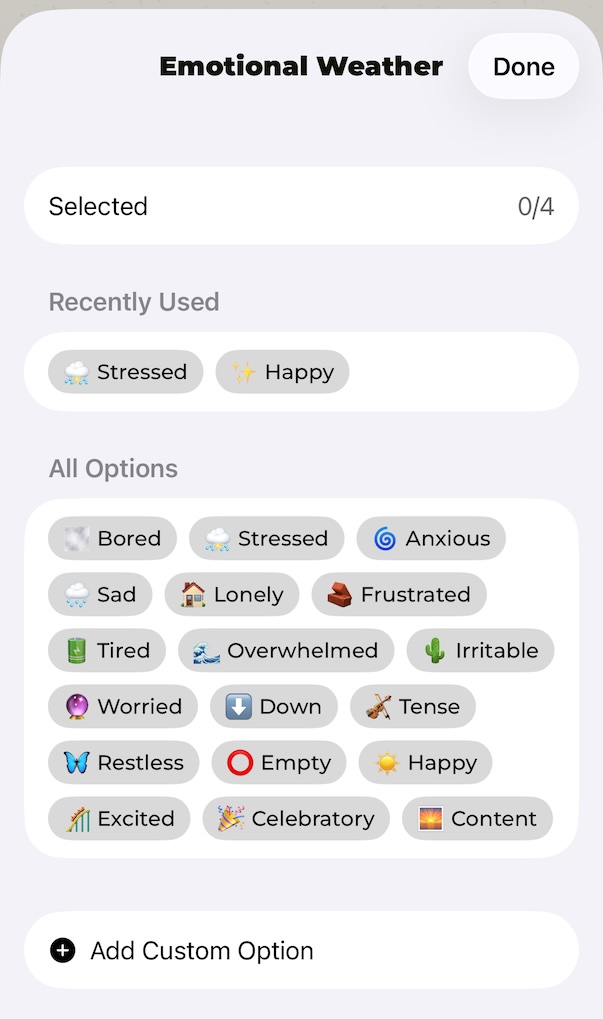
<h3 id="18-emotions-zero-shame">18 Emotions, Zero Shame</h3>

<p>Most eating trackers focus on food. ProsoPlate focuses on what’s happening inside you - and that means tracking emotions.</p>

<p>But emotion tracking done poorly can reinforce negative patterns. Done well, it builds what researchers call <em>emotional granularity</em> - the ability to distinguish “lonely” from “bored” from “tired.” In <em>How Emotions Are Made</em>, Lisa Feldman Barrett reports that people who make these fine-grained distinctions regulate their emotions markedly better - around 30% more flexibly, in the studies she cites.</p>

<p><img src="/assets/pp_emotionalWeather.jpg" alt="Emotional Weather picker in ProsoPlate" class="small right" /></p>

<p>I landed on <strong>18 emotions</strong>, in three groups:</p>

<p><strong>Core triggers</strong> (8 emotions): Bored, Stressed, Anxious, Sad, Lonely, Frustrated, Tired, Overwhelmed - these have the strongest research evidence as eating triggers.</p>

<p><strong>Secondary triggers</strong> (6 emotions): Irritable, Worried, Down, Tense, Restless, Empty - moderate evidence, often variants of the core triggers.</p>

<p><strong>Positive emotions</strong> (4 emotions): Happy, Excited, Celebratory, Content - because research shows positive emotions <em>increase</em> food intake more often than negative emotions decrease it. Most apps ignore this entirely.</p>

<p><strong>What I deliberately left out:</strong> Shame never appears in ProsoPlate. The research is clear - shame creates spirals that reinforce problematic eating patterns. Guilt (“I did something I regret”) can motivate change. Shame (“I am bad”) links to pathology. This is a firm design boundary.</p>

<p>I’ll be honest - I’m still experimenting with whether to group emotions or leave them flat as they are now. How best to present them in the Evening Review remains an open question. But the app records everything, so don’t skip this step. I’m fairly sure it will start showing you patterns within a few weeks.</p>

<hr />

<h3 id="seeing-the-spaces-between-meals">Seeing the Spaces Between Meals</h3>

<p>When we think about mindful eating, we focus on the meal itself. But what about the gaps?</p>

<p>This update introduces <strong>meal timing awareness</strong>:</p>

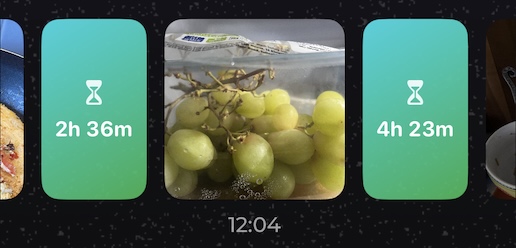
<p><img src="/assets/pp_timegap.jpg" alt="Hourglass tiles showing time between meals" class="center" /></p>

<ul>
  <li><strong>Hourglass tiles</strong> show the time between meals - whether it’s “2h 15m” or “45m”. No judgment, no targets, just information.</li>
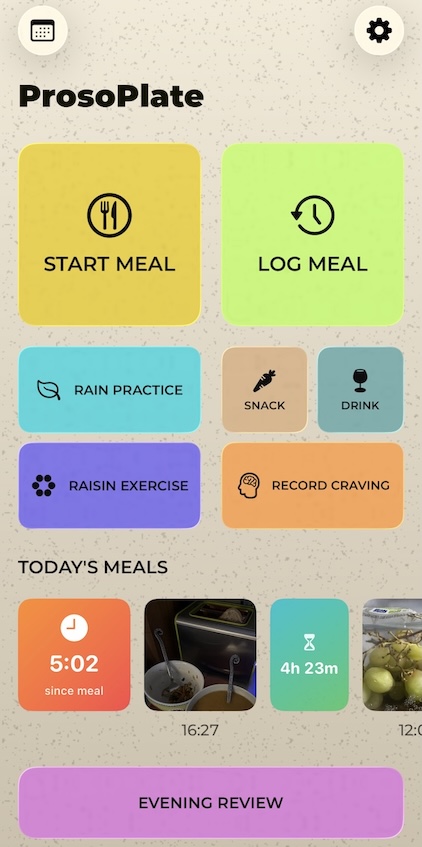
  <li><strong>Time Since Last Meal</strong> appears on your home screen, answering a surprisingly hard question: “When did I last eat?”</li>
  <li><strong>Yesterday’s reminder</strong> - notes from your Evening Review appear the next morning on your home screen.</li>
</ul>

<p>I’ve already found patterns I never noticed: a seven-hour gap between lunch and dinner on office days, completely different spacing at the weekend, a lot more snacking when I work from home. None of that shows up in a calorie count.</p>

<p><img src="/assets/pp_lastmeal.jpg" alt="Time Since Last Meal on home screen" class="small center" /></p>

<hr />

<h3 id="the-mindful-awareness-timeline">The Mindful Awareness Timeline</h3>

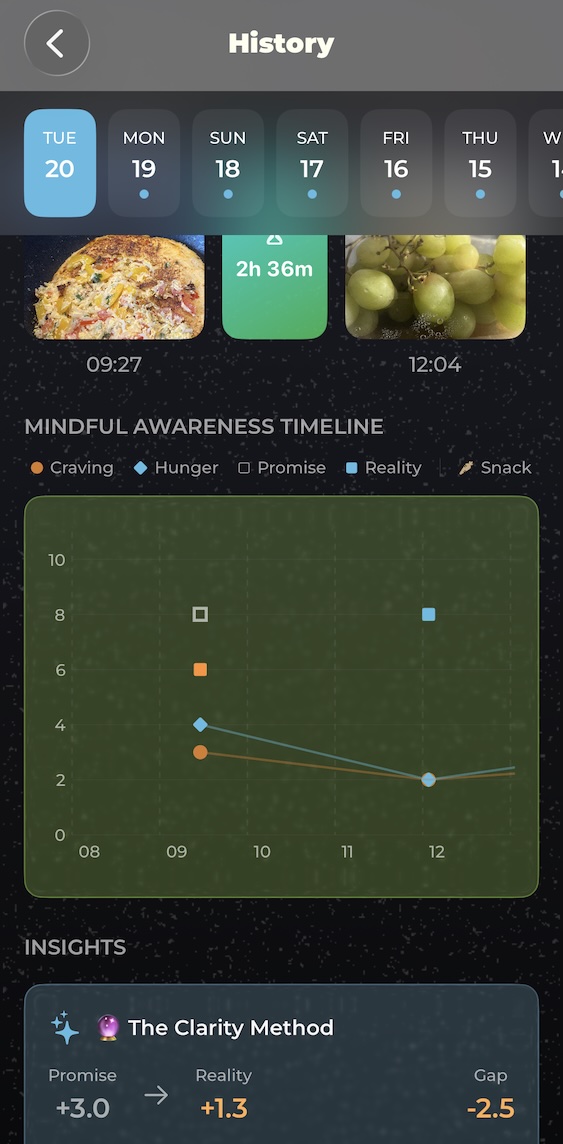
<p>This feature appears in both Evening Review and History: a multi-dimensional visualization of your eating day.</p>

<p>The Timeline shows six data series:</p>

<table>
  <thead>
    <tr>
      <th>Symbol</th>
      <th>What It Shows</th>
    </tr>
  </thead>
  <tbody>
    <tr>
      <td>Orange circle</td>
      <td>Craving intensity before eating</td>
    </tr>
    <tr>
      <td>Teal diamond</td>
      <td>Hunger level before eating</td>
    </tr>
    <tr>
      <td>Empty square</td>
      <td>The Promise - what your mind said you’d get</td>
    </tr>
    <tr>
      <td>Filled square</td>
      <td>The Reality - what you actually experienced</td>
    </tr>
    <tr>
      <td>Carrot icon</td>
      <td>Snack logged</td>
    </tr>
    <tr>
      <td>Wine glass</td>
      <td>Alcohol logged</td>
    </tr>
  </tbody>
</table>

<p>This is the part of the app where I have high hopes and am still experimenting. More changes coming soon.</p>

<p><img src="/assets/pp_timeline.jpg" alt="The Mindful Awareness Timeline in the Evening Review" class="small center" /></p>

<hr />

<h3 id="the-curiosity-principle">The Curiosity Principle</h3>

<p>Throughout these features I follow what I call the <strong>curiosity principle</strong>: the app helps you notice patterns with interest, not track compliance with goals.</p>

<ul>
  <li>No streaks</li>
  <li>No targets or ideal distributions</li>
  <li>No comparison to other users</li>
  <li>No red flags or color-coded judgment</li>
</ul>

<p>The assumption: awareness precedes change. When people see their patterns clearly, they make their own adjustments. ProsoPlate makes patterns visible. What you do with that visibility is yours.</p>

<hr />

<h3 id="try-it">Try it</h3>

<p>All three are in the update, nothing to configure. Use ProsoPlate as you normally would and see what turns up.</p>

<p>Record a few meals with the full flow, log some snacks, then open your Evening Review and explore the Timeline. Tap the legend items. See what happens when you focus on just craving, or just the Promise/Reality gap.</p>

<p>The pattern might surprise you.</p>

<hr />

<p><em>ProsoPlate is available on the <a href="/prosoplate/">App Store</a>. Built on the <a href="/methods/clarity-method/">Clarity Method</a> - tracking experiences, not calories.</em></p>]]></content><author><name>Bart Smaga</name></author><category term="[&quot;mindful-eating&quot;]" /><category term="dev" /><category term="article" /><category term="prosoplate" /><category term="release" /><summary type="html"><![CDATA[Today’s ProsoPlate update brings three interconnected features that deepen how you can observe your eating patterns. Each one emerged from research and from my own experience using the app daily.]]></summary></entry><entry><title type="html">The First Few Weeks</title><link href="https://prosoche.co/2026/prosoplate-first-weeks/" rel="alternate" type="text/html" title="The First Few Weeks" /><published>2026-01-13T00:00:00+00:00</published><updated>2026-01-13T00:00:00+00:00</updated><id>https://prosoche.co/2026/prosoplate-first-weeks</id><content type="html" xml:base="https://prosoche.co/2026/prosoplate-first-weeks/"><![CDATA[<h4 id="learning-to-pause-before-the-plate">Learning to Pause Before the Plate</h4>

<p>ProsoPlate is now live in the App Store. But before making it public, I wanted to use it myself - not as a developer testing features, but as someone genuinely trying to change their relationship with food. A few weeks in, I have my first real insight to share.</p>

<hr />

<h3 id="the-hardest-part-isnt-the-app">The Hardest Part Isn’t the App</h3>

<p>The biggest challenge I’ve encountered has nothing to do with the interface, the features, or the technology. It’s much simpler and much harder: <strong>remembering to use it</strong>.</p>

<p>When hunger strikes or a craving emerges, my default pattern is immediate action. See food, eat food. The space between impulse and action has been compressed over decades of habit. ProsoPlate asks me to insert a pause into that moment - to stop, open the app, check in with my hunger level, note any cravings before I eat.</p>

<p>This pause is the entire point. And it’s precisely what makes it difficult.</p>

<h3 id="building-the-habit">Building the Habit</h3>

<p>For the first week or so, I kept forgetting. I’d finish half a meal before realizing I hadn’t logged anything. Sometimes I’d remember only during the Evening Review, looking back at a day with gaps where awareness should have been.</p>

<p>But I kept at it. Not perfectly - just persistently.</p>

<p>Around the two-week mark, something shifted. The pause started to feel less like an interruption and more like a natural part of eating. Opening ProsoPlate before a meal became less of a conscious effort and more of an automatic response. The habit was forming.</p>

<h3 id="stop-slow-down">Stop. Slow Down.</h3>

<p>What I’m really training isn’t app usage - it’s the capacity to <strong>stop and slow down</strong>. The app is just a tool that creates structure around that intention. Without it, “eating mindfully” remains a nice idea that dissolves the moment real hunger or a genuine craving appears.</p>

<p>With ProsoPlate, I have a concrete action: open the app, rate my hunger, note what I’m experiencing. This tiny ritual creates enough friction to interrupt autopilot mode. And in that interruption, there’s space for awareness.</p>

<h3 id="whats-next">What’s Next</h3>

<p>The app is still very much in development. I’m collecting data from my own usage - patterns in cravings, gaps between anticipated and actual satisfaction, times when mindful eating clicks and times when it doesn’t.</p>

<p>My focus for upcoming improvements is everything related to the <strong>Evening Review</strong>. This is where the real learning happens: looking back at the day’s eating experiences, noticing patterns, building that “disenchantment database” that Dr. Brewer describes. The Review is where scattered data points become genuine insight.</p>

<p>For now, though, the lesson is simple: the app only works if you use it. And using it means building a new habit - learning to pause at exactly the moment when pausing feels most unnatural.</p>

<p>Two weeks in, it’s starting to click.</p>

<hr />

<p><em>ProsoPlate is available on the <a href="/prosoplate/">App Store</a>. It’s built on the <a href="/methods/clarity-method/">Clarity Method</a>, which draws from Dr. Judson Brewer’s research on habit change and craving.</em></p>]]></content><author><name>Bart Smaga</name></author><category term="[&quot;mindful-eating&quot;]" /><category term="article" /><category term="mindfulness" /><category term="prosoplate" /><summary type="html"><![CDATA[Learning to Pause Before the Plate]]></summary></entry></feed>